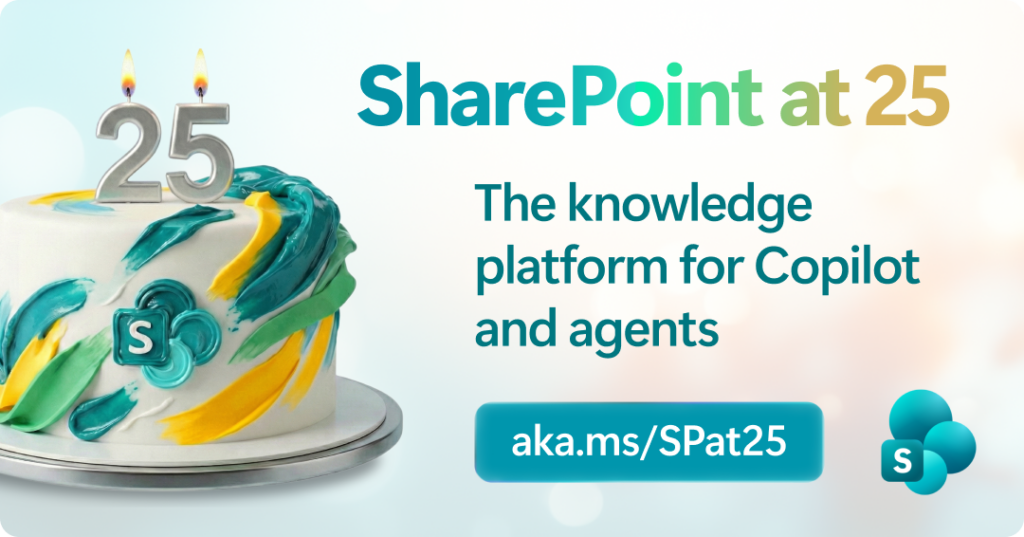
SharePoint turns 25 on March 2. For me, that is more than a milestone in the Microsoft world. It is a personal checkpoint, because SharePoint has been with me throughout my entire professional life as a consultant.
My first SharePoint memories go back to the on-prem era around SharePoint 2003 and 2007. It was a different time: multi server SharePoint Farms, team sites, document libraries, and a lot of hands-on work with structure and permissions. Requirements and challenges were more on the Search and custom design side of things. At least at my customers. Who remembers that implementing a simple thing like wildcard search requires a third party addon back in the SharePoint 2007 days.
But the most memorable moments were never about features. They were about behavior change. The first time a team stopped emailing attachments and started collaborating in one shared place, you could literally see productivity and clarity improve.
Over the years, SharePoint has reinvented itself repeatedly. It moved from classic portal thinking to modern Microsoft 365 experiences where collaboration, content, and communication come together. As SharePoint evolved from on‑premises farms to SharePoint Online and ultimately to Office 365 and Microsoft 365, I followed that shift deliberately. My interest was always in solutions rather than infrastructure, which made adopting SharePoint Online from day one a natural choice. At the same time, the on‑premises years gave me essential grounding in high availability, SQL-Server, DNS, and Active Directory—knowledge I wouldn’t want to miss.
And today Microsoft positions SharePoint as the knowledge platform for Copilot and agents. That framing is important, because AI changes the question from “Where is the document?” to “How do I get to the right answer and the right next step quickly?”
This is also why the fundamentals matter even more again. Information architecture, governance, ownership, and adoption are not the boring parts. They are the difference between content that is just stored somewhere and content that becomes usable knowledge at scale. Especially when it is meant to power Copilot and modern agent experiences.
One thing stayed constant over all these years: the community. SharePoint’s story is strongly shaped by people who build with it, teach it, and share what works and what does not. I have always loved that part of the ecosystem, because it turns individual project experience into something everyone can learn from.
Happy birthday, SharePoint. And thank you to everyone in the community who helped shape the last 25 years. I’m genuinely excited to see what the next chapter looks like.
Schreibe einen Kommentar